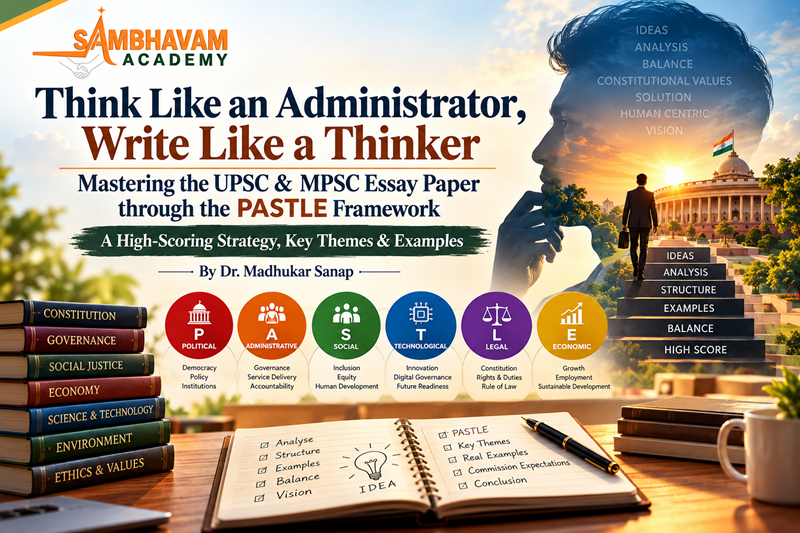
Think Like an Administrator, Write Like a Thinker
Mastering the UPSC & MPSC Essay Paper through the PASTLE Framework
By Dr. Madhukar Sanap
Introduction: Why the Essay Paper Deserves a Separate Strategy
Among all the papers in the UPSC and MPSC Civil Services Main Examinations, the Essay paper offers a distinctive opportunity to demonstrate qualities that cannot always be adequately reflected through conventional General Studies answers. Yet, it is frequently underestimated. Many aspirants believe that a good essay primarily requires excellent language, impressive vocabulary, quotations, current-affairs knowledge or the ability to write at length. These certainly help, but they do not by themselves produce a high-quality civil services essay. A strong essay reflects something deeper: clarity of thought, analytical depth, multidimensional understanding, logical organisation, balance, originality, constitutional sensitivity and mature judgment.
In a General Studies paper, the candidate is largely responding to a defined question. In an Essay paper, the candidate has much greater freedom and therefore much greater responsibility—to decide how the issue should be interpreted, organised and examined. This is precisely why Essay preparation requires a strategy of its own.
The central principle is simple:
A high-scoring essay does not merely demonstrate what you know; it demonstrates how well you can think with what you know.
Understanding What the Commission Expects
The Essay paper should not be viewed as a test of literary talent. The candidate is not expected to write like a novelist or philosopher. What matters is the ability to remain relevant to the subject, organise ideas coherently, analyse different dimensions and express arguments clearly and concisely.
From the perspective of a civil services examination, the examiner is effectively assessing several qualities simultaneously.
Has the candidate understood the real meaning of the topic? Can the candidate move beyond obvious arguments? Can different dimensions of an issue be connected logically? Can competing perspectives be acknowledged? Can evidence be used without turning the essay into a collection of facts? Can the candidate eventually arrive at a balanced and constructive position?
These expectations can be expressed through a simple formula:
Relevance + Depth + Structure + Balance + Evidence + Values + Effective Expression
An aspirant should therefore approach an essay not as a long answer, but as a structured journey of thought.
The PASTLE Approach: A Framework for Multidimensional Thinking
One of the most common difficulties aspirants face after selecting an essay topic is deciding how to expand it meaningfully.
They may understand the subject but struggle to generate enough dimensions. Alternatively, they may know many facts but fail to organise them into a coherent argument.
The PASTLE approach can solve this problem.
PASTLE represents six important analytical lenses:
P - Political
A - Administrative
S - Social
T - Technological
L - Legal
E - Economic
When confronted with an essay topic, the candidate can mentally examine it through these six lenses. This does not mean that every essay must contain six separate sections titled Political, Administrative, Social and so on. PASTLE is primarily a brainstorming and analytical framework.
Its purpose is to ensure that the candidate does not look at a complex issue from only one perspective.
Political Perspective: Institutions, Democracy and Power
The political dimension examines how an issue relates to democracy, representation, participation, leadership, political accountability, decentralisation, federalism and public policy.
Consider an essay on the relationship between technology and democracy.
A political analysis may explore how digital platforms have expanded citizen participation and access to information. At the same time, it may examine misinformation, deepfakes, political polarisation, manipulation of public opinion and the influence of algorithms on democratic discourse.
The objective is not simply to declare technology good or bad. It is to demonstrate the ability to recognise its democratic possibilities as well as democratic risks.
That balance is essential in civil services writing.
Administrative Perspective: Governance and Implementation
The administrative dimension is particularly important in UPSC and MPSC because the examination is ultimately selecting future public administrators.
Candidates should ask:
What does this issue mean for governance?
An administrative perspective may involve efficiency, transparency, accountability, public-service delivery, grievance redressal, corruption, institutional capacity, decentralisation, implementation gaps and citizen-centric governance.
For example, Artificial Intelligence may help governments analyse large datasets, detect fraud, improve targeting of welfare schemes and strengthen public-service delivery.
However, another question immediately arises:
Can administrative accountability ever be transferred to an algorithm?
Technology may assist an administrator, but responsibility, discretion, empathy and constitutional accountability ultimately remain human responsibilities.
Such analysis demonstrates administrative maturity.
Social Perspective: Who Benefits and Who Is Left Behind?
The social dimension brings people to the centre of the essay.
For almost every policy or developmental issue, an aspirant should ask:
Who benefits? Who bears the cost? Who may be excluded?
The answer may require examining gender, caste, class, rural-urban differences, tribal communities, youth, elderly citizens, persons with disabilities, education, health, migration and social inequality.
For MPSC candidates, Maharashtra's rich tradition of social reform provides valuable intellectual and historical material.
The contributions of Mahatma Jyotirao Phule, Savitribai Phule, Rajarshi Shahu Maharaj, Dr. B.R. Ambedkar and Baba Amte, among others, can enrich essays dealing with education, equality, dignity, social justice and empowerment.
However, personalities should never be mentioned merely for decoration. Their ideas and contributions should strengthen the argument being developed.
Technological Perspective: Innovation with Responsibility
Technology is increasingly relevant across essay themes, not only in essays explicitly dealing with science.
Artificial Intelligence, automation, social media, digital governance, biotechnology, cybersecurity, FinTech, space technology and digital education are transforming society, governance and the economy.
A mature essay should avoid the assumption that:
Technology automatically equals progress.
Technology can expand opportunity, but it can also produce new forms of inequality, surveillance, exclusion and dependence.
The better analytical equation is:
Technology + Accessibility + Regulation + Ethics + Inclusion = Meaningful Progress
This approach allows an aspirant to appreciate innovation without becoming technologically deterministic.
Legal Perspective: Rights, Rule of Law and Constitutionalism
Civil services essays should demonstrate constitutional sensitivity wherever the topic permits.
The legal perspective may include Fundamental Rights, Directive Principles, legislation, judicial interventions, institutional safeguards, regulatory frameworks, rights and duties, and the rule of law.
However, simply mentioning constitutional Articles is not enough.
The deeper question should be:
What constitutional value is at stake?
- Equality leads us towards social justice.
- Liberty raises questions of autonomy and individual freedom.
- Article 21 leads towards life and human dignity.
- Directive Principles invite discussion of welfare and socio-economic justice.
The Preamble provides the broader framework of:
Justice - Liberty - Equality - Fraternity
An essay becomes more mature when constitutional provisions are transformed into constitutional values.
Economic Perspective: Growth, Opportunity and Distribution
Almost every major social or governance challenge has an economic dimension.
Candidates can examine growth, employment, poverty, inequality, productivity, entrepreneurship, agriculture, infrastructure, public expenditure, financial inclusion, human capital and regional disparities.
Consider Artificial Intelligence.
A superficial argument may state:
“AI will create new employment opportunities.”
A deeper essay asks:
- What kind of employment?
- Which existing jobs may disappear?
- Who possesses the skills required for new opportunities?
- Could technological ownership concentrate wealth further?
- How should governments prepare workers for the transition?
The difference lies in moving from a statement to an analysis of consequences.
PASTLE Is a Starting Point, Not a Limitation
A common mistake would be to mechanically force every essay into the six PASTLE dimensions.
That should be avoided.
PASTLE is a foundation. Depending upon the topic, candidates should add other relevant perspectives, particularly:
- Historical - How has the issue evolved?
- Environmental - What are its ecological and sustainability implications?
- Ethical - What questions of fairness, responsibility, integrity and justice arise?
- Constitutional - Which fundamental constitutional values are involved?
- Global - What are the international implications?
- Individual/Psychological - How does the issue influence human behaviour, choice, dignity and responsibility?
The larger analytical toolkit therefore becomes:
PASTLE + Historical + Environmental + Ethical + Constitutional + Global + Individual
The principle, however, remains simple:
Use the dimensions that illuminate the topic. Never use dimensions merely to fill pages.
From Topic to Essay: A High-Scoring Writing Framework
A good essay begins before the first sentence is written.
Candidates should spend the initial brainstorming time understanding the topic, identifying its central proposition and creating a logical structure.
A useful sequence is:
Decode → Define → Develop → Diversify → Debate → Demonstrate → Deliver
- First, decode the exact meaning of the topic.
- Then define your central thesis.
- Develop the argument logically.
- Diversify the analysis through PASTLE and other relevant dimensions.
- Debate the issue by recognising counterarguments.
- Demonstrate your arguments through examples and evidence.
- Finally, deliver a balanced and forward-looking conclusion.
This sequence prevents the essay from becoming a collection of disconnected paragraphs.
Writing an Introduction That Creates Impact
The opening of an essay establishes its intellectual tone.
Avoid generic statements such as:
“Development is very important for every country.”
Such an opening is correct, but it says almost nothing.
Consider instead the topic:
“The True Measure of Development Is the Dignity It Creates.”
A stronger opening could be:
A nation may build expressways, skyscrapers, airports and sophisticated digital networks, yet its development remains incomplete if a child is denied education, a woman lives without security, a farmer struggles without economic dignity or an elderly citizen is deprived of basic care. Development ultimately derives its meaning not merely from what a nation builds, but from the quality of life it enables its people to live.
The introduction performs three functions simultaneously: it creates interest, interprets the topic and establishes the direction of the essay.
The Central Thesis: The Invisible Thread of the Essay
Every strong essay requires a central argument.
Suppose the topic is:
“Development Without Inclusion Is Growth Without Progress.”
A possible thesis could be:
Economic expansion acquires the character of genuine development only when its opportunities and benefits enhance human capabilities, reduce inequality and protect the dignity of the wider population.
The thesis becomes the invisible thread connecting every subsequent paragraph.
A candidate may discuss the economy, education, technology, women, governance or environmental sustainability but each discussion must eventually reconnect with the central idea of inclusive development.
Applying PASTLE: A Worked Example
Consider the topic:
“Artificial Intelligence Can Augment Human Intelligence, But Cannot Replace Human Wisdom.”
An effective essay could begin with humanity's long history of creating tools to expand its capabilities from the wheel and printing press to electricity, computers and Artificial Intelligence.
But AI raises a fundamental distinction:
Intelligence can calculate. Wisdom must judge.
- From the political perspective, AI can support evidence-based policymaking, while misinformation, deepfakes and algorithmic manipulation can threaten democratic processes.
- From the administrative perspective, AI can improve public-service delivery, resource allocation and fraud detection. Yet governments cannot outsource accountability to machines.
- From the social perspective, AI can expand access to education and healthcare, but unequal access may deepen existing inequalities.
- From the technological perspective, AI can dramatically enhance human capability, but technological capability itself does not establish ethical legitimacy.
- From the legal perspective, AI creates important questions concerning privacy, intellectual property, discrimination, liability and accountability.
- From the economic perspective, AI can increase productivity and create new industries while simultaneously disrupting traditional employment and increasing the urgency of reskilling.
The ethical dimension takes the argument further.
- A machine may process millions of medical records, but can it understand suffering?
- An algorithm may identify patterns in judicial decisions, but can justice be reduced to probability?
- A government may automate welfare decisions, but what happens when an algorithm excludes a vulnerable citizen?
This leads towards the synthesis:
The future should not be framed as Human versus Machine. It should be built around Human Wisdom empowered by Machine Intelligence.
That is how PASTLE helps convert a broad topic into a coherent, multidimensional essay.
Philosophical Essays Require a Different Use of PASTLE
Philosophical topics should not be forced into a conventional policy-analysis structure.
Consider: “The Greatest Battles Are Fought Within.”
The essay could begin with the individual struggle between:
- Fear and courage, greed and contentment, ego and humility, convenience and conscience, prejudice and reason.
- It can then gradually widen its canvas.
- At the level of society, internal prejudice can become discrimination.
- In politics, the struggle may be between the pursuit of power and commitment to democratic values.
- In administration, a civil servant may confront the conflict between external pressure and constitutional duty.
- In economic development, societies confront the choice between unlimited consumption and sustainability.
- In technology, humanity faces the question of whether technology will remain a tool or begin determining human behaviour.
The essay therefore progresses organically from:
Self → Society → State → Nation → Humanity
Such progression gives a philosophical essay depth and coherence.
Use Examples as Evidence, Not Decoration
Examples can significantly strengthen an essay, but only when their relevance is explained.
A weak use of an example would be:
“Savitribai Phule worked for women's education.”
A stronger version would be:
Savitribai Phule's pioneering struggle for women's education demonstrates that genuine social transformation often begins by challenging inequality in access to knowledge. Her legacy remains relevant even today as India attempts to move beyond enrolment towards meaningful and equitable educational opportunity.
The principle is:
Example → Interpretation → Connection with the Topic
This converts information into analysis.
The same approach should be followed while using statistics, reports, historical events, court judgments, personalities or current affairs.
UPSC and MPSC: Common Foundation, Different Contextualisation
The fundamentals of good essay writing remain largely common to both UPSC and MPSC: relevance, coherence, multidimensional analysis, balance, effective expression and a constructive conclusion.
However, MPSC aspirants should consciously build a strong Maharashtra-specific repository of examples.
Essays can be enriched, wherever relevant, through Maharashtra's social reform movements, cooperative movement, women's education, agriculture, water-management initiatives, local self-government, industrialisation, urbanisation, regional disparities and environmental challenges.
Similarly, thinkers and reformers from Maharashtra can provide intellectual depth.
The key is contextualisation rather than forced localisation.
For UPSC, the canvas should naturally expand from the individual and local level towards India and the wider world.
Prepare Themes, Not Predicted Essays
Essay preparation should not become an exercise in predicting examination questions.
Instead of memorising dozens of ready-made essays, candidates should develop mastery over broad thematic clusters such as:
Democracy and Constitution; Governance and Public Administration; Social Justice and Equality; Women and Gender; Education and Youth; Science, Technology and Artificial Intelligence; Economy and Inclusive Development; Agriculture and Rural Transformation; Environment and Sustainability; Ethics and Human Values; Globalisation and International Relations; and Philosophy and Human Behaviour.
For every major theme, prepare a compact repository containing:
Core arguments → PASTLE dimensions → constitutional connections → examples → thinkers → current developments → counterarguments → possible solutions.
With such preparation, even an unfamiliar essay topic becomes manageable.
Build Your Personal Essay Resource Bank
Successful Essay preparation requires accumulation of usable knowledge, rather than random information.
Maintain a dedicated notebook or digital repository containing authentic quotations, constitutional principles, major thinkers, historical examples, contemporary case studies, government initiatives, administrative innovations, credible reports and useful statistics.
For MPSC, maintain a separate Maharashtra-specific section. The objective is not to reproduce everything you know in the examination.
Remember:
Evidence should strengthen an argument. It should never replace the argument.
What Commonly Reduces Essay Scores?
- Several otherwise knowledgeable candidates lose marks because they treat an essay as an extended General Studies answer. Information dumping, excessive factual content, one-dimensional analysis, repetition, extreme positions, unnecessary quotations and overly decorative language weaken the quality of an essay.
- Another common mistake is mechanically using frameworks. PASTLE should organise your thinking; the examiner does not need to see a rigid sequence of six labelled compartments.
- Equally important is avoiding excessive negativity. Civil services essays should recognise problems realistically while retaining the capacity to identify solutions.
- A future administrator is expected not merely to identify what is wrong, but also to consider what can reasonably be done about it.
The Art of a High-Scoring Conclusion
A conclusion should not simply repeat the introduction.
It should elevate the discussion.
A strong conclusion generally moves:
From Problem → Possibility
From Conflict → Balance
From Present → Future
From Policy → Values
From National Interest → Larger Human Purpose
For an essay on development, for example:
India's development journey cannot ultimately be measured only through the size of its economy, kilometres of highways or scale of technological advancement. Its deeper success will be determined by whether growth expands human capabilities, protects dignity, reduces inequality and provides every citizen a meaningful opportunity to participate in national progress. The purpose of development, therefore, is not merely to create a richer economy, but to build a more capable, just and humane society.
The conclusion should give the examiner a sense that the intellectual journey of the essay has reached its destination.
A Practical Formula for the Examination Hall
When you see an essay topic, remember:
1. Decode
What exactly is the topic asking?
2. Establish the Thesis
What central argument will guide the essay?
3. Apply PASTLE
Political – Administrative – Social – Technological – Legal – Economic.
4. Expand Where Necessary
Historical – Constitutional – Ethical – Environmental – Global – Individual.
5. Add Evidence
Examples, reports, constitutional values, thinkers and contemporary developments.
6. Introduce the Counterview
What is the other side of the argument?
7. Balance
Avoid absolute or ideological conclusions.
8. Suggest the Way Forward
Move from criticism towards constructive possibilities.
9. Conclude with Vision
End with constitutional values, human dignity, optimism and future orientation.
In essence:
Decode → Thesis → PASTLE → Evidence → Counterview → Balance → Solutions → Vision
The Final Self-Assessment
Before completing the paper, an aspirant should mentally examine the essay against a few fundamental questions.
- Have I remained relevant to the exact topic?
- Is my central thesis visible throughout the essay?
- Have I examined sufficient dimensions rather than repeating the same argument?
- Have I used PASTLE intelligently rather than mechanically?
- Are my examples supporting my arguments?
- Have I recognised legitimate counterarguments?
- Does my essay reflect constitutional and ethical maturity?
- Is there a natural flow between paragraphs?
- Is the language simple, precise and effective?
- Does the conclusion leave the examiner with a strong final thought?
This final review can substantially improve the quality of the answer.
Conclusion: Think Like an Administrator, Write Like a Thinker
The UPSC and MPSC Essay papers are not competitions in vocabulary. Nor are they examinations of how many facts, quotations or reports an aspirant can reproduce.
They are fundamentally tests of structured thinking, intellectual balance, judgement and communication.
A future civil servant will constantly encounter competing considerations:
- Growth versus Equity.
- Development versus Environment.
- Technology versus Privacy.
- Authority versus Liberty.
- Efficiency versus Compassion.
- Individual Rights versus Collective Interest.
Good administrators cannot afford to see these questions only in black and white.
Neither should good essays.
The PASTLE approach (Political, Administrative, Social, Technological, Legal and Economic) provides a systematic framework for understanding complexity. Historical, ethical, environmental, constitutional, global and individual perspectives can then be added wherever the subject demands greater depth.
But no framework can substitute for independent thought.
- PASTLE gives structure.
- Knowledge gives substance.
- Examples give credibility.
- Balance gives maturity.
- Values give direction.
- Practice gives mastery.
Ultimately, a high-scoring essay is not the essay that contains the maximum information.
It is the essay in which the examiner can recognise a clear mind, analytical depth, balanced judgement, constitutional values and the temperament expected of a future civil servant.
Read Widely. Think Deeply. Analyse through PASTLE. Write Structurally. Revise Critically.
Dr. Madhukar Sanap